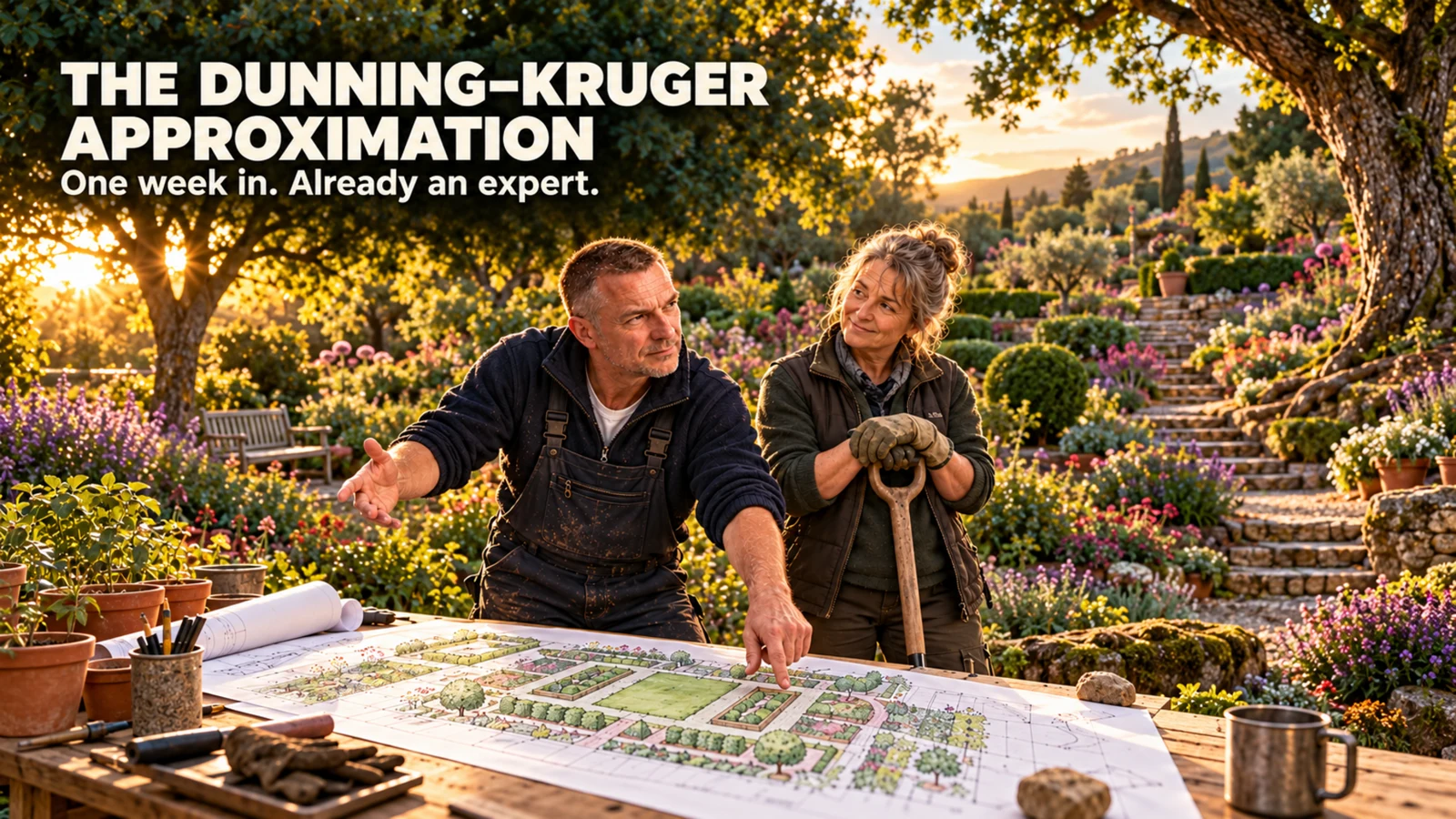
Oh, how many times have I done this?
One week in a gardening team.
Already full of very clever advice.
Very clever.
Very early.
Luckily, the colleague in this picture seems kindly disposed towards me.
She’s listening.
The spade is still resting on the ground.
I count that as a good start.
The leaves disagreed
Have you ever tried moving a large pile of leaves in one specific direction with a high-powered leaf blower on a busy street?
I used to clean ships’ cargo holds with a fire hose.
Surely I had some transferable skills.
The leaves disagreed.
There I was, feeling like a complete idiot, hoping my colleagues would give me time to learn.
Then there’s the grass trimmer.
In experienced hands, it looks effortless. Learning that control takes months. Until then, enthusiasm can leave quite a mark on the property.
I had watched people do these things and thought I understood the work.
I mistook their mastery for the simplicity of the task.
“Now I’ve got it.”
I’ve spent a considerable part of my life learning things.
Guitar. Unicycling. Juggling. Steel mace. Kettlebells. Motorcycling. Programming. Speaking on stage. Teaching. New jobs.
Again and again, I’ve had that wonderful moment:
“Now I’ve got it.”
Usually shortly before discovering what I hadn’t got yet.
A different situation. A bad day. Something that worked yesterday suddenly refusing to cooperate.
Being good at one thing has never given me a free pass into the next. I still have to learn the work.
What I do bring with me is a growing willingness to question the feeling that I already understand.
That feeling can be remarkably convincing.
A little knowledge. A very complete explanation.
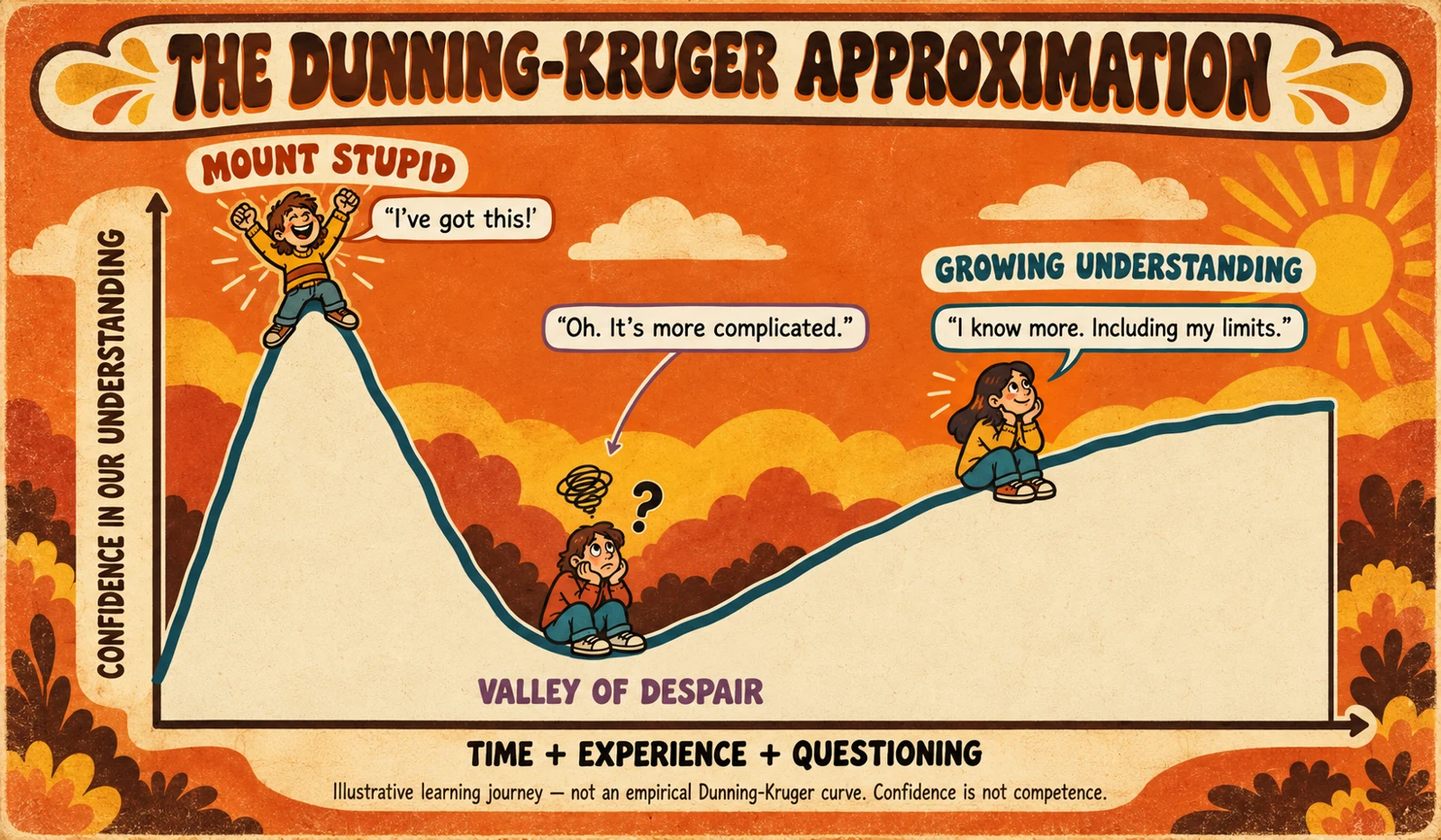
Dunning and Kruger studied how people assess their own abilities. Their original research found substantial overestimation among participants with low performance in the tested domains, linked in part to difficulty recognising their own errors.
My gardening adventures aren’t a psychological diagnosis. But they give me a very personal reason to examine the gap between confidence and understanding.
The familiar “Mount Stupid” and “Valley of Despair” illustration captures something I recognise in my learning: early certainty, the discovery of complexity, and a slower, more grounded understanding.
It’s an illustration, not the curve measured in the original study. And the vertical axis is confidence. Our knowledge doesn’t necessarily disappear when our confidence does.
Sometimes we’re finally learning enough to see what we’ve been missing.
Murphy arranges the site visit
People doing the work often have every reason to say:
“You don’t understand what this job actually takes.”
Knowing the job title isn’t knowing the work.
Even having done the job isn’t the same as doing it here, with this team, these tools, and these conditions.
And when we finally visit to see for ourselves?
Murphy arranges the visit.
Everything runs beautifully.
Or everyone is having a break.
“Looks straightforward.”
Excellent. We’ve now mistaken a quiet moment for a complete understanding.
The work it takes to make things look easy is often the work we never see.
The bottle-cleaner trap
One person cleans 100 bottles an hour.
Ten people clean 1,000.
Beautiful arithmetic.
Do we have ten cleaning stations?
Enough water pressure?
Who supplies the bottles?
Who checks them?
Where do they go afterwards?
The calculation could be right. We need to establish whether its assumptions hold.
We multiplied the people.
We haven’t checked whether the work can scale.
And that brings me to a question that matters enormously in leadership:
Who estimates the effort — especially when I’m already convinced I understand the job?
My confidence isn’t an estimate.
Let’s build one with the people who will actually do the work.
Otherwise, we risk a familiar sequence:
“I knew how long it should take.
I didn’t ask the people doing it.
And when it took longer, I questioned their performance.”
Perhaps I should have questioned my estimate first.
My unchecked assumption can become somebody else’s supposed performance problem.
How do we practise Humility — and avoid the “I know it all” trap?
For me, it starts with treating “That looks easy” as a reason to ask a question.
“What do you understand about this work that I haven’t learned to see yet?”
Then I need to stay long enough to hear the answer.
Observe more than one convenient moment. Ask about the difficult days, the exceptions, the preparation, and the recovery afterwards.
Build estimates with the people doing the work. Make the assumptions visible. Find out what depends on somebody else.
And when reality differs from the plan, investigate together.
What did we miss?
What changed?
What needs to happen now?
Let’s get curious before we get corrective.
I have to remind myself of that almost every day.
My first impulse often knows the way to drama.
Curiosity helps me find out what’s actually going on.
Our internal software loves a simple explanation.
A little familiarity.
A plausible story.
“Got it.”
Dunning and Kruger give us a reason to pause before trusting that feeling.
My internal human software has declared the problem understood.
Reality hasn’t signed off yet.
So how do I outsmart my own shortcut?
#Humility.
“What am I missing?”
“Who sees something I don’t?”
“Can you show me?”
And then comes the difficult bit:
Letting the answers change my mind.