And I'm looking for the company that's serious about changing that.
I have been talking about people for a very long time.
Two of the strongest slides I ever put on a stage said:
“It’s all about people, and what those people do.”
“Digital business is a people business.”
I meant every word.
People were never an afterthought in my work. They were the point.
But I didn't know then what I know now.
Because there is a difference between believing in people — and standing beside them at six
in the morning.
I left the ivory tower.
For years, I worked in digital transformation.
APIs. Platforms. Ecosystems. Organizational change.
I wrote books about it. I taught it. I stood on stages and talked about it.
Then I left.
I put on work clothes and became a facility technician.
And somewhere between early shifts, broken machines, dirty hands and conversations over
coffee, my understanding of organizations changed.
Not my belief that people matter.
My understanding of how much of them organizations never get to see.
I will always be grateful that I was given the opportunity to enter this world. It taught me
more about organizations than I ever expected to learn.
The people our ease of life rests on.
I met people I had barely met in my previous professional life.
Not because they weren't there.
Because I wasn't where they were.
People who clean our buildings. Repair our machines. Prepare our food. Keep our
infrastructure running.
People on whose shoulders much of our comfortable ease of life rests.
And I developed a profound respect for them.
For people mastering their lives on salaries many executives would barely notice.
For people largely cut off from the kind of education I had learned to take for granted.
For people living with existential financial worries — and rarely complaining about them.
I have met people for whom signing documents they cannot fully understand has become a
normal part of life.
People who cannot negotiate on equal terms because they do not have the language.
People who are not asking whether their next job will fulfil them.
They are simply glad to have a job.
They show up. Every day.
And they receive nowhere near the recognition they deserve.
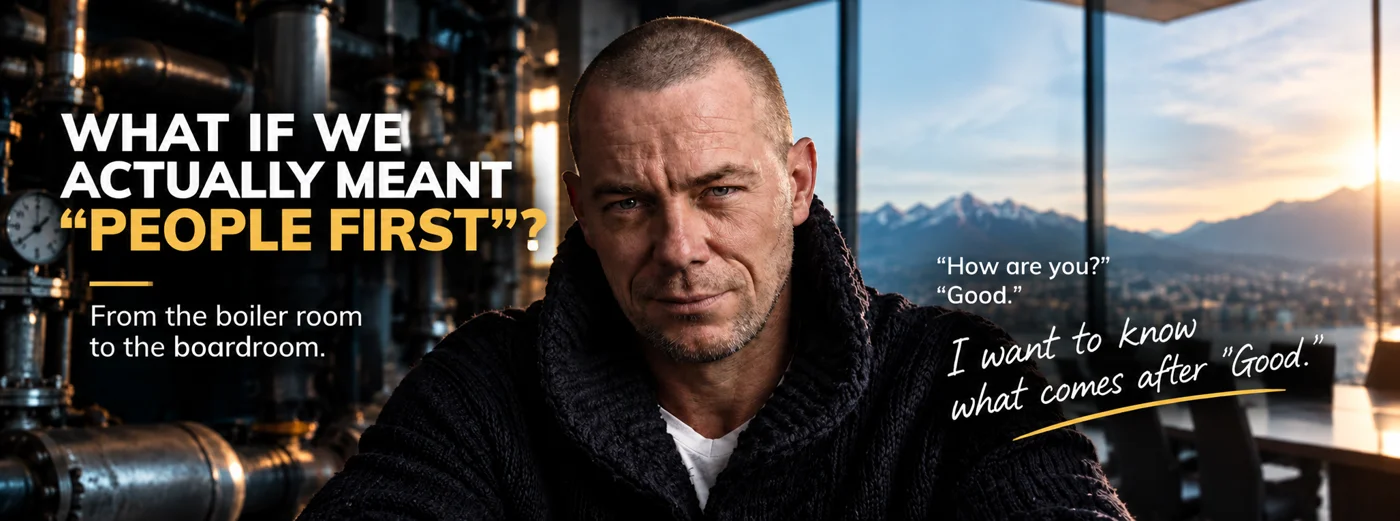
“Wie geht’s?”
Here in Switzerland, we have a little ritual.
We meet someone and ask: “Wie geht’s?”
How are you?
And the answer is almost always: “Gut.”
Good.
Because most of the time, nobody really wants to know.
I do.
I want to know what comes after “Gut.”
What makes your work unnecessarily difficult.
What you're worried about.
What you have learned not to say because experience taught you that nobody would listen.
What you know about this organization that nobody in the boardroom knows.
What you could do if somebody actually gave you the opportunity.
And whenever I can, I try to help.
What if we actually meant “People First”?
I have become convinced that most organizations are sitting on an extraordinary amount of
human intelligence they never use.
Intelligence doesn't begin with a university degree.
Creativity doesn't belong to management.
Leadership isn't determined by an org chart.
And the person cleaning a machine may understand what is wrong with the process better
than the person who designed it.
So imagine what would happen if a large organization started taking that seriously.
Really seriously.
Not another employee survey.
Not another values poster.
Not another People First slide.
But a fundamental assumption:
The people working here have the intelligence, capability and heart to
take this organization to places management alone never could.
Then let's build around that assumption.
Let's find the friction — and remove it.
Let's give people agency.
Let's listen to the people closest to the work.
Let's make language a bridge instead of a barrier.
Let's stop treating the workforce as a cost to optimize and start treating it as the enormous
reservoir of human capability it actually is.
And now there is AI.
It is time.
AI will become better at things we once believed were uniquely ours.
Faster. More knowledgeable. More analytical. More productive.
We shouldn't fight that.
We should meet it with the one thing AI can never become: human.
With empathy. With courage. With dignity. With intuition. With responsibility. With the
ability to truly care about another human being.
For decades, organizations have tried to make people more like machines: predictable,
measurable, standardized, efficient.
Maybe it's time we did the opposite.
Let machines become better machines.
Let humans become better humans.
That's the transformation I'm interested in.
So here is what I know now.
There is one role that could make me leave the boiler room again.
A role with the mandate to take everything I have learned here and combine it with
everything I learned in the decades before.
Call it Chief People & Transformation Officer.
The title doesn't matter much to me.
The mandate does.
The mandate to go from the boiler room to the boardroom — and back again.
To find the intelligence an organization isn't using.
To find the friction that prevents people from doing their best work.
And to remove it.
To find out what this organization could become if we started taking its people seriously.
Really seriously.
Only call me if you mean it.
Don't call me because you need someone to run HR.
Don't call me because People & Culture needs a refresh.
And don't call me because the employee engagement score needs to go up three points.
Call me if you're prepared to mean it.
Because then we are going to ask uncomfortable questions.
We are going to listen to people we haven't listened to before.
We are going to challenge things that have been “just the way we do things” for twenty years.
We are going to move decision-making closer to where the work actually happens.
We are going to remove friction.
And yes: things will change.
A lot.
And if nobody calls?
That's perfectly fine.
I have a job. I have made a commitment. And I intend to honour it.
Tomorrow morning, I'll put on my work clothes and go read the heating meters.
I'll fix something that's broken.
I'll have coffee with people I've grown to deeply respect.
And I'll probably ask someone: “Wie geht’s?”
And when they say “Gut” —
I'll still want to know what comes after that.