The same mistake again. The same employee. How many times do you have to explain this! Someone needs to call him in for a talk.
Why do we call people in, anyway? Sounds a bit like calling in a faulty appliance. I’d rather invite someone for a conversation. Although. If my boss invited me for a conversation, I’d probably get nervous too. Maybe it isn’t the wording.
Anyway, the employee is sitting there now -- He needs to start taking more ownership.
That’s a lovely word. There’s freedom in it -- Being an adult. Trusting someone to do something. I like that! I’m just wondering why ownership so often enters the conversation at work only after something has gone wrong.
Before that, he always had to ask.
Let’s assume the employee actually made a mistake. No sneaky little hero story where all employees turn out to be brilliant and all managers are idiots. He overlooked something. Made a decision that wasn’t good. Perhaps he even knew better.
So now what?
We can establish what he did. We could also ask how he got there in the first place. What information he had. What else was expected of him at the same time. Which decisions he was allowed to make himself, and which required approval from someone who hasn’t replied since Tuesday.
Tuesday last week.
We might hear something we don’t like. For example, that he tried to follow two of our instructions at once and/or acted without asking first.
Move faster <-> Don’t take risks.
Decide for yourself <-> Check with us first.
Delight customers <-> Don’t make exceptions.
These sentences fit comfortably next to each other on a slide. Unfortunately, in someone’s life, they eventually have to meet. That often ends badly.
Thank goodness we’re not there.
When the same mistake keeps happening, things get interesting. Not pleasant. Interesting.
Perhaps someone really does lack a skill. Perhaps someone doesn’t want to do it. That happens too. But perhaps a person is doing something perfectly understandable under the circumstances. Avoiding trouble. Covering themselves. Keeping a number green. Waiting a little longer.
- We see the waiting and say he can’t work independently.
- He remembers the last time he didn’t wait.
An organisation can be extraordinarily reliable at producing exactly the behaviour it then complains about. The nasty thing is, this doesn’t even require bad intentions. Sensible individual decisions will do, if together they produce something rather senseless.
Oh, right -- there are also the people who somehow have to get through all this.
“Yes, but the KPIs.”
THERE THEY ARE - FINALLY!
I notice how comforting that sentence is - I breathe out and relax …
The numbers demand it! The pressure comes from above. Under these conditions, what else am I supposed to do?
A moment ago, I was thinking about the manager who turns his employee into the problem. Now I’ve turned the numbers into the problem, and I’m safely back on the other side.
I can’t, because .....................
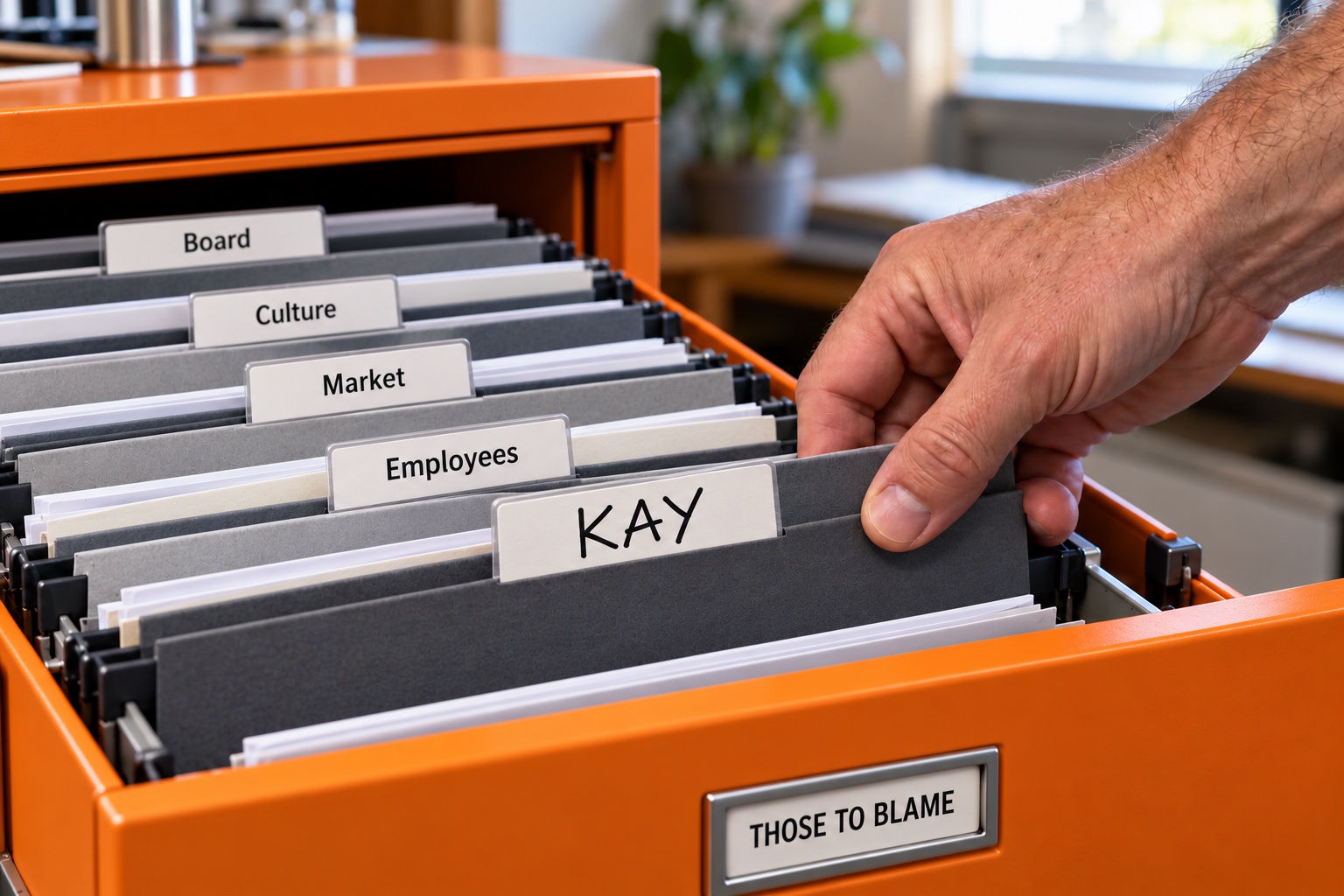
There’s an astonishing amount of room after “because”. For the board, the culture, the market, the employees who apparently just aren’t ready yet. You could set up a filing system. A hanging folder for everyone.
And somehow I forget to make one for myself.
Of course numbers create incentives. Of course power, dependency and limits exist. I can’t think them away by improving my attitude. Someone who genuinely isn’t allowed to make a decision doesn’t acquire the authority just because we use the word ownership.
Still, I’d like to know at what point I turned a constraint into a complete explanation. For everything I do. And everything I leave undone.
Which decisions do I still make myself? Whose objections have I stopped hearing? What do I pass on even though I’ve long considered it nonsense?
Perhaps my room for manoeuvre is small. I’d like more of it. But I should at least take a look before claiming there is none.
Finding someone to blame has one great advantage: I no longer have to look for my own part in it.
The other person now has quite enough to deal with.
We can end the conversation, agree on an action and carry on. The approvals remain. So do the contradictory expectations. Next time there’s a mistake, the conversation will probably be a little firmer too.
What bothers me is how easily asking about responsibility can become a source of comfort for the person asking. Someone else needs to learn something. I have exercised leadership.
Surely a leadership position should make it possible to examine the conditions we help create. Including the ones we benefit from. Who still challenges me before something goes wrong? What do people learn from the way I respond to bad news? Which problems get reworded on their way to me until they apparently aren’t problems anymore?
And then I wonder why nobody told me in time.
Before I invite him to our next conversation, I have five more questions. For myself, unfortunately.
- Who have I already declared to be the problem before understanding what’s happening here?
- What comes after “I can’t, because …” when I say it -- and what would I have to do if I couldn’t leave it there?
- What could I have changed by now while waiting for everyone else to finally see sense?
- What part of my own contribution to this problem would I rather not examine too closely?
- What do I gain by being right? And who pays for it?
And then one more, which really wasn’t supposed to be here:
What would Mum say if she could see me now?
All I wanted was a quick word with him about his mistake.
Now I’m still sitting here.
Him? He left ages ago.